Zadejte základní Astrup
Vyplňte pH, pCO₂ v kPa a aktuální reportované HCO₃⁻ v mmol/l. U arteriálního vzorku doplňte pO₂ nebo saturaci, pokud je požadována oxygenace.
VÝUKOVÁ APLIKACE PRO ACIDOBAZICKOU ROVNOVÁHU · DATA SE NEUKLÁDAJÍ
Zadávejte dostupné údaje a sledujte, jak každý nález mění další krok algoritmu, interpretaci i doporučení k doplnění.
INTERAKTIVNÍ VÝUKA ABR
Vyberte případ a projděte rozhodování krok za krokem. Závěr se zobrazí až po vaší odpovědi.
Výsledky se neukládají. Trénink je výuková pomůcka a nenahrazuje klinické rozhodnutí.
STRUČNÝ NÁVOD K POUŽITÍ
Začněte minimem a další údaje doplňujte podle právě aktivní diagnostické větve. Výsledek se po každé změně automaticky přepočítá.
Vyplňte pH, pCO₂ v kPa a aktuální reportované HCO₃⁻ v mmol/l. U arteriálního vzorku doplňte pO₂ nebo saturaci, pokud je požadována oxygenace.
Červené hlášení označuje nemožnou nebo zásadně nekonzistentní kombinaci a výpočet zastaví. Žluté hlášení označuje mimořádně neobvyklý, ale možný nález; po ověření jednotek a přepisu jej lze vědomě potvrdit.
Otevřete zvýrazněné sekce. „Nutné doplnit“ obsahuje údaje potřebné k dokončení větve. „Doporučené“ představuje užitečný klinický kontext, který neblokuje základní vyhodnocení.
Nejprve zkontrolujte průběžný závěr a přítomné procesy, potom kompenzaci, AG, delta ratio a osmolární gap. „Kam zaměřit pozornost“ uvádí další nevyřešený krok, nikoli automatickou diagnózu.
Tlačítko „Jak vznikl tento závěr?“ zobrazí rozhodovací cestu, použité vzorce, dosazení a interpretaci. Záložka „Schéma algoritmu“ nabízí přehled celého postupu.
Tlačítko „Nový případ“ vymaže všechny vložené hodnoty. Aplikace klinická data neukládá; nezadávejte identifikační údaje pacienta.
Tréninkový režim vede uživatele od rozpoznání primární poruchy přes výpočty až k diagnostické větvi, aniž by předem zobrazil správný závěr.
K dispozici je DKA, laktátová HAGMA, průjmová NAGMA, RTA 4 a chronická respirační acidóza.
U výběrové otázky označte jednu možnost. Číselný výsledek lze zadat s desetinnou čárkou nebo tečkou; aplikace toleruje běžné klinické zaokrouhlení.
Nápověda připomene správný princip nebo vzorec, ale neprozradí hotovou odpověď.
Po kontrole se zobrazí, zda je odpověď správná, a proč. Potom pokračujte další otázkou.
Skóre počítá správné odpovědi v aktuálním spuštění. Výsledky se nikam neodesílají ani neukládají.
Doporučený způsob výuky: nejprve řešte případ bez nápovědy, potom si projděte vysvětlení a nakonec stejný případ zopakujte s vlastním výpočtem na papíře.
Nepřevádějte na mmHg před zadáním.
Výjimkou jsou pole, u kterých je přímo uvedena jiná jednotka.
Bez údaje nelze aktivní větev dokončit.
Upřesňuje klinický kontext, ale neblokuje větev.
PŘEHLED CELÉHO ROZHODOVACÍHO POSTUPU
Souhrnná mapa vstupních dat, určení primární poruchy, kontroly kompenzace a navazujících větví.
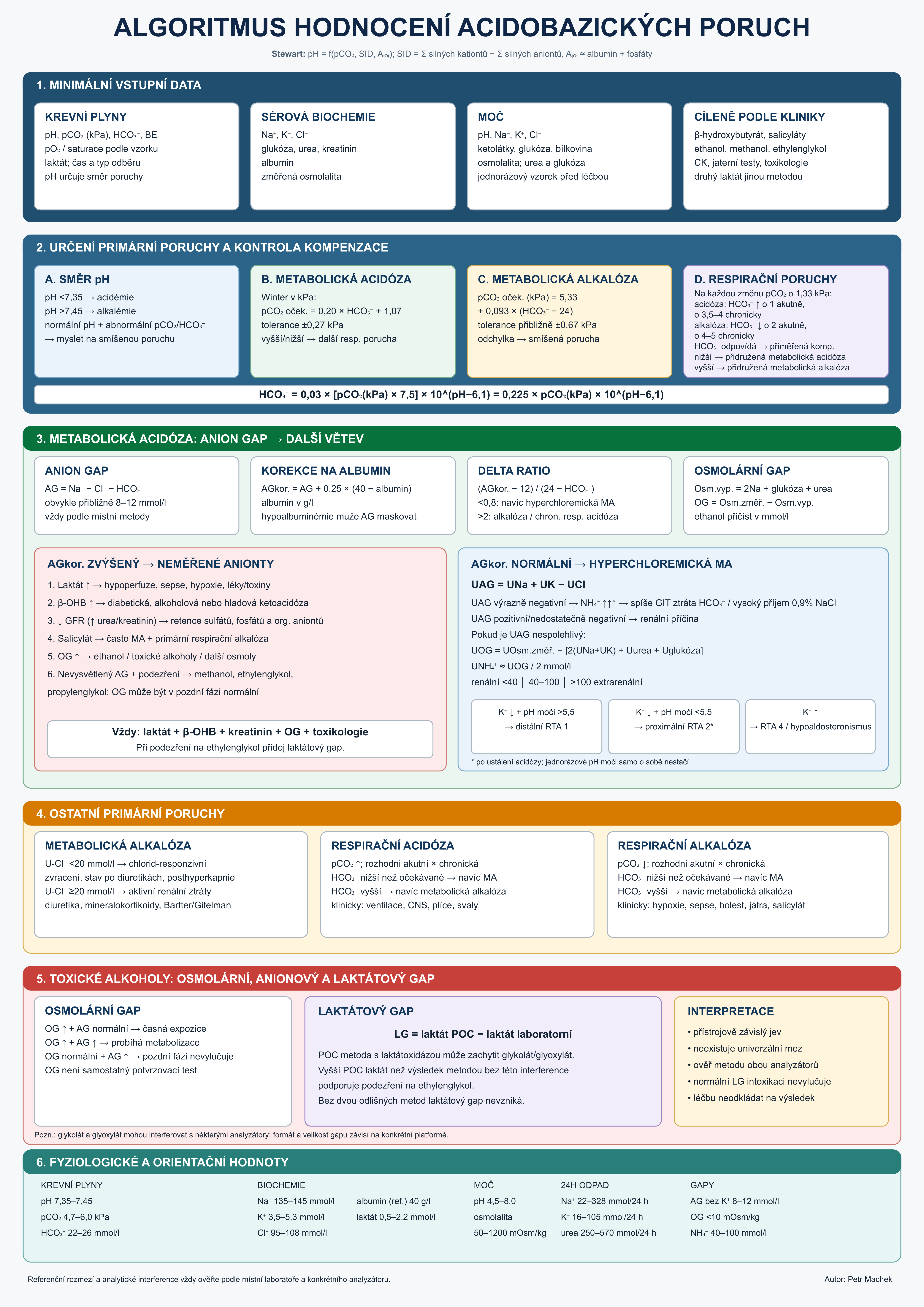
Stewart: pH = f(pCO₂, SID, Atot); SID = strong cations − strong anions; Atot ≈ albumin + phosphate
pH, pCO₂ (kPa), HCO₃⁻, base excess, pO₂/saturation, lactate, sampling time and specimen type.
Na⁺, K⁺, Cl⁻, glucose, urea, creatinine, albumin and measured osmolality.
pH, Na⁺, K⁺, Cl⁻, ketones, glucose, protein, osmolality, urea; use a paired pretreatment spot sample.
β-hydroxybutyrate, salicylate, ethanol, methanol, ethylene glycol, CK, liver tests and toxicology.
pH < 7.35 → acidemia
pH > 7.45 → alkalemia
Normal pH with abnormal pCO₂/HCO₃⁻ → consider a mixed disorder.
Winter equation in kPa:
expected pCO₂ = 0.20 × HCO₃⁻ + 1.07
tolerance ±0.27 kPa.
Expected pCO₂ (kPa) = 5.33 + 0.093 × (HCO₃⁻ − 24)
approximate tolerance ±0.67 kPa.
For each 1.33 kPa change in pCO₂: acidosis raises HCO₃⁻ by 1 acutely or 3.5–4 chronically; alkalosis lowers HCO₃⁻ by 2 acutely or 4–5 chronically. A deviation suggests a mixed disorder.
HCO₃⁻ = 0.03 × [pCO₂(kPa) × 7.5] × 10(pH−6.1) = 0.225 × pCO₂(kPa) × 10(pH−6.1)
AG = Na⁺ − Cl⁻ − HCO₃⁻. Use the local reference interval.
Corrected AG = AG + 0.25 × (40 − albumin in g/L).
(corrected AG − 12) / (24 − HCO₃⁻). Values <0.8 suggest additional NAGMA; values >2 suggest an alkalinizing process or chronic respiratory acidosis.
Calculated osmolality = 2Na⁺ + glucose + urea (+ ethanol, all in mmol/L). OG = measured − calculated osmolality.
Assess lactate, β-hydroxybutyrate, renal function, salicylate and the osmolal gap. If unexplained and clinically suspected, test for methanol, ethylene glycol and other toxic alcohols.
UAG = U-Na⁺ + U-K⁺ − U-Cl⁻. If unreliable, use the urine osmolal gap or directly measured U-NH₄⁺. Then distinguish gastrointestinal bicarbonate loss, chloride-rich fluid exposure, distal/proximal RTA and type 4 RTA using serum K⁺, urine pH and the clinical context.
Urine Cl⁻ <20 mmol/L suggests a chloride-responsive process; ≥20 mmol/L suggests ongoing renal chloride loss or a chloride-resistant process.
Elevated pCO₂: determine whether acute or chronic and compare HCO₃⁻ with the expected compensation.
Reduced pCO₂: determine whether acute or chronic and compare HCO₃⁻ with the expected compensation.
An increased OG with a normal AG may occur early; an increased OG and AG may indicate ongoing metabolism. A normal OG or AG does not exclude late exposure.
LG = POC lactate − laboratory lactate. Some POC methods may read glycolate/glyoxylate as lactate, providing a method-dependent clue to ethylene glycol exposure.
No universal cut-off exists. Verify both analyzer methods. A normal lactate gap does not exclude poisoning and treatment must not be delayed for this result.
Educational algorithm. Always verify reference intervals, analytical interference and treatment pathways with the local laboratory and current clinical guidance.